
Building Habits
Table of Contents
📖 Book Review - July 2024
Title: Atomic Habits
Author: James Clear
Finished on: 2024-07-31
Why I Read It
Well, it was about time to know the secret of how I can improve my habits, thus being more productive. It was the first book I found when doing some research, so I thought, why not?
Tiny changes make a big difference
Habits follow a four-step model described by the author, which we will delve into:
- Cue
- Craving
- Response
- Reward
Many people underestimate the value of making small improvements on a daily basis but overestimate the importance of one defining moment. Small improvements are often not notable, while big ones are. "Massive success requires massive action." If you do 1% better every day for one year, that will lead to about thirty-seven times improvement by the end.
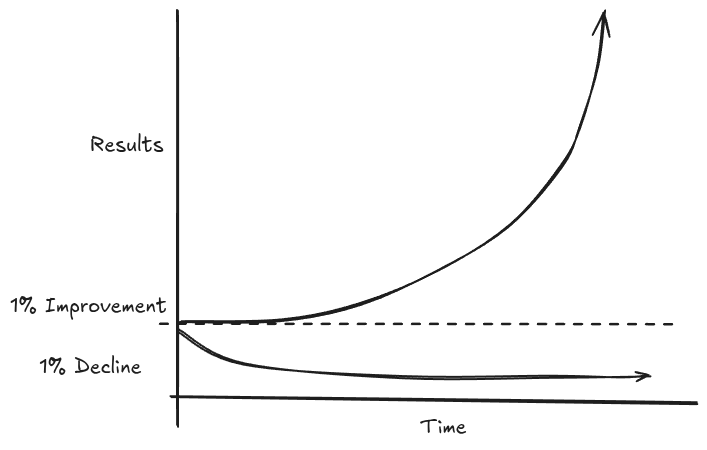
What you know as success is the product of daily (tiny) habits and not of once-in-a-lifetime transformations, which many people think of as success. It does not matter how successful or unsuccessful you are, but whether your habits are putting you on the path toward success. You should be more concerned with your current trajectory than with your current results. Habits can compound for you or against you:
| Positive Compounding | Negative Compounding |
|---|---|
| Productivity compounds: More tasks you can handle without thinking means your brain is free to focus on other areas. | Stress compounds: Frustration, heavy responsibilities, and chronic stress can compound into serious health issues. |
| Knowledge compounds: Learning one new idea won't make you a genius, but committing to lifelong learning can be transformative. | Negative thoughts compound: If you habitually view people as angry, unjust, or selfish, you'll begin to see those traits everywhere. |
| Relationships compound: Small, consistent acts of kindness in interactions build strong connections over time. | Outrage compounds: Riots, protests, and mass movements usually build slowly rather than from a single event. |
Small improvements might seem to make no difference in daily life, but if they persist long enough you will eventually reach the "Plateau of Latent Potential", which people call an overnight success, since they only see the dramatic event rather than all that preceded it.
Problem with Goals
Focusing on systems instead of goals.
Goals are the result you want to achieve someday. Systems, however, are the processes that lead to those results - the way of achieving your goal. Problems with focusing only on the goal:
1. Everyone has the same goals
Setting goals suffers from the survivorship bias - concentrating on the people who end up winning (survivors) while overlooking people who had the same objective but didn't succeed. The goals were always there, but the systems that were implemented for continuous improvement achieved different outcomes.
2. It is a momentary change
When you achieve a goal, it can change your life for the moment. People sometimes achieve goals to treat a symptom (like cleaning a room) without addressing the actual cause.
Fix the inputs and the outputs will fix themselves.
3. Goals restrict your happiness
The goal-first mentality puts happiness off until the next big milestone - a trap you should avoid.
4. The "yo-yo" effect
People set goals, achieve them, and then stop (which can be fine depending on the goal) because they have reached the goal and there is nothing more to motivate them to push forward - they revert to old habits. The purpose of a goal is to win the game, while the purpose of systems is to continue playing the game.
Focus on the overall system rather than a single goal.
Habits shape our identities
If you tried to change an existing habit you might have faced some challenges. This is because of one of these two reasons:
- You try to change the wrong thing
- You try to change the habit in the wrong way
Change can occur at these three levels:
- Changing the outcome - concerned with changing your results
- Changing the process - concerned with changing your habits and systems
- Changing your identity - concerned with changing your beliefs
Focusing on what you want to achieve is outcome-based habits, while focusing on who you want to become involves identity-based habits. To truly change your behavior, you must first focus on changing your identity.
Four Simple Steps for Building Better Habits
Behavior followed by satisfying consequences tends to be repeated.
A habit is basically the process of automating a task (or solution) that has been repeated often enough that the brain begins to automate the process of performing or solving it. This leads to decreased brain activity when doing the task, as there is no need to analyze every angle of the situation.
The process of building a habit can be divided into four steps:
- Cue
- Craving
- Response
- Reward
The cue triggers your brain to initiate a behavior - a bit of information that predicts the reward. The second step is craving, the motivational force behind every habit - the reason to act. The third step is response, the actual habit performed - a thought or an action. Finally, the response delivers a reward, which satisfies the craving. The final step closes the feedback loop and completes the habit cycle.
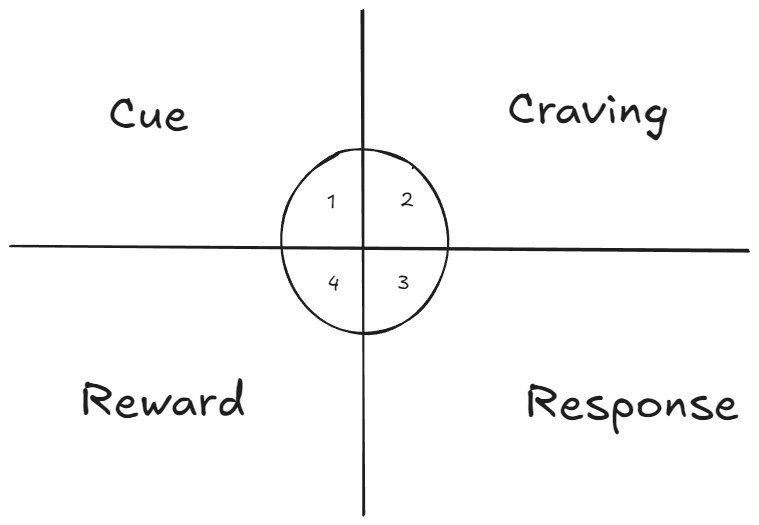
The Laws - Make It ...
To create good habits you need to apply the four-step model and use the laws stated below to make the process of creating good habits effortless. The inversion of the laws can also be used to break bad habits.
Obvious (Cue)
With enough practice, you can pick up on the cues that predict certain outcomes without consciously thinking about them.
The cues that spark our habits become so common over time that they are essentially invisible to us.
You can use a method called "Pointing and Calling", which raises the level of awareness from a non-conscious habit to a more conscious level. In this method you actively call something out so you remember it - when leaving your house you can say, "I have my keys, my wallet, and my phone." The more often you do this, the more automatic it becomes, and you will be less likely to have to consciously think about it.
To utilize this method, use a Habit Scorecard system, where you write down all your behaviors so you become more aware of them. After writing them down, add a + in front of the habit if it is a good habit, a - for a bad habit, and = for a neutral habit. This may vary depending on your goal and situation. While a good habit may seem hard to do in the short term, it will benefit you in the long term, while a bad habit does the opposite.
Finally, you can implement the Pointing and Calling method by calling out the bad behavior when you are about to do it, thus making you aware of it. In this way, the consequences of the bad habit will feel more real, which adds weight to the action.
Starting a Habit
Some methods which you can apply to actually get started doing a habit:
- Implementation Intentions
You can use this method to plan beforehand when and where to act.
When situation X arises, I will perform response Y.
This method works because when you make a specific plan for when and where, you are more likely to follow through and perform the new habit.
You can apply this strategy by filling out this sentence:
I will [BEHAVIOR] at [TIME] in [LOCATION]
Example: I will exercise for one hour at 5 p.m. in my local gym.
- Habit Stacking
This method helps you use the Implementation Intentions method. There is an effect called the Diderot Effect, which states that obtaining a new possession often creates a spiral of consumption that leads to additional purchases. Many people follow this cycle as they often decide what to do next based on what they have just finished doing. To build new habits, identify a current habit you already do each day and then stack your new behavior on top.
After I [CURRENT HABIT], I will [NEW HABIT].
Example: After I take off my work shoes, I will immediately change into my workout clothes.
Once you have mastered the basic structure, you can create larger stacks by chaining small habits together.
Motivation is Overrated
People often choose products not because of what they are, but because of where they are.
Your behavior is a function of the person in their environment - B = f(P,E)
Every habit is initiated by a cue, and the more a cue stands out the more likely we will notice it. However, this also depends on the environment because some cues might not even get noticed if there is no obvious trigger. Over time your habits become associated not with a single trigger but with the entire context (environment) surrounding the behavior. Make sure that your cue for a habit is obvious in your environment.
Attractive (Craving)
When an opportunity is attractive enough, it is more likely to become habit-forming. To increase the odds of a behavior occurring, make it attractive. Habits are part of a dopamine-driven feedback loop. Highly habit-forming activities, such as playing video games or watching TikTok, are associated with higher levels of dopamine. Dopamine is released not only when you experience pleasure but also when you anticipate it (for example, gambling, where you anticipate a high reward).
Desire is the engine that drives behavior.
We need to make habits attractive because the expectation of a rewarding experience motivates us to act. Use Temptation Bundling to link an action you want to do with an action you need to do. For example, you want to watch a movie (something you want to do) but also need to get your steps in. You can combine these by watching the movie while getting your steps on a treadmill. Combine this with the Habit Stacking method mentioned earlier:
- After I [CURRENT HABIT], I will [HABIT I NEED].
- After [HABIT I NEED], I will [HABIT I WANT].
Role of Family and Friends
Role of Family and Friends
A genius is not born, but is educated and trained.
Humans are herd animals - we want to fit in, bond with others, and earn the respect of our peers. We don't choose our earliest habits; we often imitate them from friends, family, and school without thinking or questioning. The groups we imitate habits from are:
- The close - people around us such as friends, family, and partners
- The many - we look at others to guide us when unsure; groups can overpower an individual's desired behaviors
- The powerful - humans pursue power, prestige, and status and find it attractive; we copy successful people because we desire success ourselves
Fixing habits
Cravings come from deep within and motivate you to act. They are specific manifestations of deeper underlying motives. Your habits are modern-day solutions to ancient desires. They are all about associations, which determine whether we predict a habit to be worth repeating. To make hard (good) habits more attractive, associate them with positive experiences - reframe your habits to highlight their benefits and reprogram your mind. This can also help fix bad habits by highlighting the benefits of avoiding them.
Easy (Response)
We tend to focus on figuring out the best approach so that we never get around to taking action. When you are in motion, you are planning, strategizing, and learning - which is good - but motion doesn't produce results. Actions, however, deliver outcomes. When you stay in motion rather than taking action, you delay failure. The key to mastering a habit is repetition, not perfection.
Each time you repeat an action, you activate the neural circuit for that habit. Putting in reps is one of the most critical steps to encode a new habit. All habits go from effortful practice to automatic behavior, also known as automaticity, the ability to perform a behavior without thinking about each step.
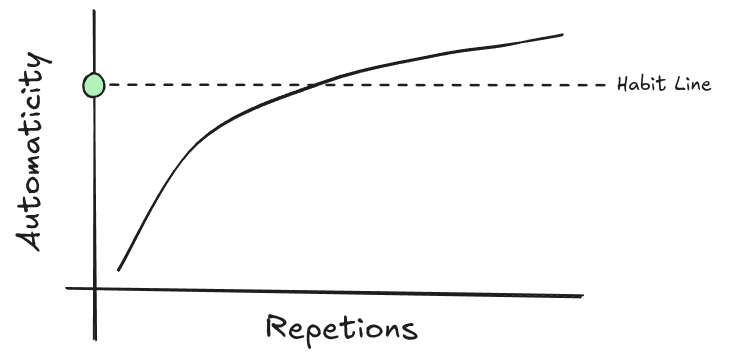
Law of least effort
A common idea is that motivation is the key to habit change - if we really wanted it, we would do it. But people's real motivation is to be lazy and do what is convenient. We follow the principle of least effort: given two similar options, we naturally choose the one that requires the least effort. The more effort required, the less likely the habit will occur. People don't do habits because they like the habit itself; rather they want the outcome the habit delivers.
To make our habits simple so we actually follow through, we need to reduce the friction associated with the habit - modify our environment. The idea is to create an environment where doing the right thing is as easy as possible. For example, if you want to read a book in the morning, instead of putting it in a drawer, place it on your desk where you can see it in the morning. This principle can also be used to break bad habits by adding friction to make them more difficult.
Two-minute rule
This rule splits your habit into progressively harder goals: very easy, easy, moderate, hard, and very hard. When you start a new habit, scale it down to a two-minute version. For example, reading a book:
- Very easy - read one sentence / open the book
- Easy - read one page with a two-minute timer
- Moderate - read 5 pages
- Hard - read 15-20 minutes or 10-15 pages in one sitting
- Very hard - read a full chapter / 30 minutes daily and take notes
The idea is to make your habit as easy as possible to start.
Satisfying (Reward)
People adapt to something that provides a strong positive sensory signal.
When you experience pleasure from a behavior, you tell your brain it is worth remembering and repeating - conversely, we have little reason to repeat an experience that does not satisfy us.
Reward is repeated, while punishment is avoided.
While the first three laws increase the odds a behavior is performed this time, the fourth law increases the odds that a behavior will be repeated the next time - completing the habit loop.
The key to sticking with a habit is to make us feel successful, even in a small way. One approach is reinforcement, the process of using an immediate reward to increase the rate of a behavior. Immediate reinforcement helps maintain motivation in the short term while waiting for long-term rewards.
For this you can use the Paper Clip Strategy, which gives a visual measure - clear evidence of progress. The best way to measure progress for a habit is with a habit tracker. A habit tracker is a simple way to record whether you did a habit, and it provides several benefits such as:
- It is obvious - recording your last action creates a trigger that can initiate your next one
- It is attractive - it can have an addictive effect on motivation as each win feeds desire
- It is satisfying - when you cross an item off your list, it feels good to watch the result grow; this helps focus on the process rather than only the result
Even if you are consistent with your habit, life will interrupt you at some point. When this happens, remind yourself of this simple rule: never miss twice.
Another thing is that while habit tracking is a nice way to visualize progress, it gives only a limited picture of what is really going on. The dark side is that we become driven by the number rather than the purpose behind it. Choose the right measurement, because measurement only makes sense if it guides us and adds context to the larger picture; otherwise it will consume us.
This law can also be applied to break bad habit - by making it immediately unsatisfying. The more immediate the pain, the less likely the behavior.
Another method to stick with a habit is a habit contract, a verbal or written agreement in which you state your commitment to a particular habit and the punishment that will occur if you don't follow through. Then find someone to act as your accountability partner and sign off on the contract with you.
The book also includes an entire chapter on advanced tactics entitled "How to go from merely good to truly great", which has additional tips, but I won't summarize it here :) (you'll have to find it yourself)
Personal reflection
I have to say that this book has helped me a lot. I have applied methods such as implementation intentions in the form of a calendar, where I write down the tasks or habits I want to implement and their dates in my journal. In my journal I track habits like going to the gym, reading books, and taking supplements. It's a really good book that I can recommend to anyone who is just starting out or having trouble maintaining habits.
Would I recommend it?
Absolutely!
Looking ahead
Next: Never Split the Difference - a book about negotiating when the stakes are high.